S-Corp for Contractors: The Complete 2026 Guide
If you’re running a contracting business (HVAC, plumbing, electrical, concrete, pool, decks, whatever your trade) and you’re still a sole proprietor or a plain LLC, there’s a real chance you’re handing the IRS thousands of dollars you didn’t have to.
The fix a lot of contractors have never heard explained in plain English is the S-Corp election.
This is the complete guide. Not a sales pitch. By the time you finish reading, you’ll understand what an S-Corp actually is, how to elect it step by step (with the real IRS form links), when it makes sense, when it doesn’t, what the IRS requires of you after you do it, and who should help you set it up.
This article is for specialty trade contractors doing roughly $1M+ in revenue who want to stop overpaying. Let’s get into it.
Key Takeaways
- An S-Corp is a TAX status, not a business type. You keep your LLC. You just tell the IRS to tax it differently.
- The savings come from self-employment tax. As a sole prop, all your profit gets hit with 15.3% self-employment tax. As an S-Corp, only your salary gets hit. The rest comes out as a distribution with no self-employment tax.
- The rough threshold is about $70,000 in net profit. Below that, the extra costs (payroll, a separate tax return) usually eat the savings. Above it, you start winning.
- You elect it by filing IRS Form 2553. And the deadline matters (2 months and 15 days into the tax year).
- You HAVE to pay yourself a “reasonable” salary. This is the part the IRS actually audits. You can’t pay yourself $10K and take $200K in distributions.
- An attorney is the wrong person for this. They know the legal side, not the tax side. They won’t set your reasonable comp or run your payroll. We had a contractor come to us who paid an attorney $50,000 for an S-Corp election. That’s not a typo.
What an S-Corp Actually Is (in plain English)
Here’s the thing almost nobody explains right. An S-Corp is not a type of business you go start. It’s a tax election.
Your LLC is a LEGAL entity. It’s the thing that protects your personal assets, holds your business name, signs your contracts. That doesn’t change.
“S-Corp” is a TAX classification. It’s you telling the IRS, “Hey, tax my LLC’s income the S-Corporation way instead of the default way.” That’s it. Your LLC keeps existing. Your business cards don’t change. Your customers never know the difference.
So when someone says “should I be an LLC or an S-Corp?” that’s actually the wrong question. The real answer for most contractors is this: you’re an LLC that ELECTS to be taxed as an S-Corp. Both. One is your legal wrapper, the other is how the tax gets calculated.
If you take one thing from this section: LLC means legal, S-Corp means tax. They’re not competing. They stack.
Why Contractors Overpay Without It
By default, if you’re a sole proprietor or a single-member LLC, every dollar of profit your business makes gets hit with self-employment tax, 15.3%, on top of your regular income tax. That 15.3% is 12.4% for Social Security and 2.9% for Medicare, per the IRS self-employment tax rules.
Say your plumbing company nets $200,000 after all your crews, materials, trucks, and overhead. As a sole prop, that whole $200K gets run through the self-employment tax machine. That’s roughly $28,000 before you even get to income tax.
With an S-Corp, you split that profit into two buckets:
- A reasonable salary you pay yourself through payroll. This part gets hit with payroll taxes (same 15.3%, just called FICA now).
- A distribution, the rest of the profit. This part is NOT subject to self-employment or payroll tax.
That second bucket is where the money stays in your pocket. We’ll do the full math in the self-employment tax savings breakdown, but the short version: contractors in the right situation save somewhere between $5,000 and $15,000+ a year. Every year. From one paperwork decision.
How to Elect S-Corp Status: Step by Step
This is the part people make sound way more complicated than it is. Here’s the actual process.
Step 1: Have (or form) an LLC
You need a legal entity first. Most contractors already have an LLC. If you’re still a straight sole proprietor, you form the LLC through your state first. (In Florida, that’s through the Florida Division of Corporations / Sunbiz.)
Step 2: Get an EIN if you don’t have one
You need an Employer Identification Number from the IRS. It’s free. You get it directly at IRS.gov. Do NOT pay one of those junk sites $300 to “file it for you.”
Step 3: File Form 2553
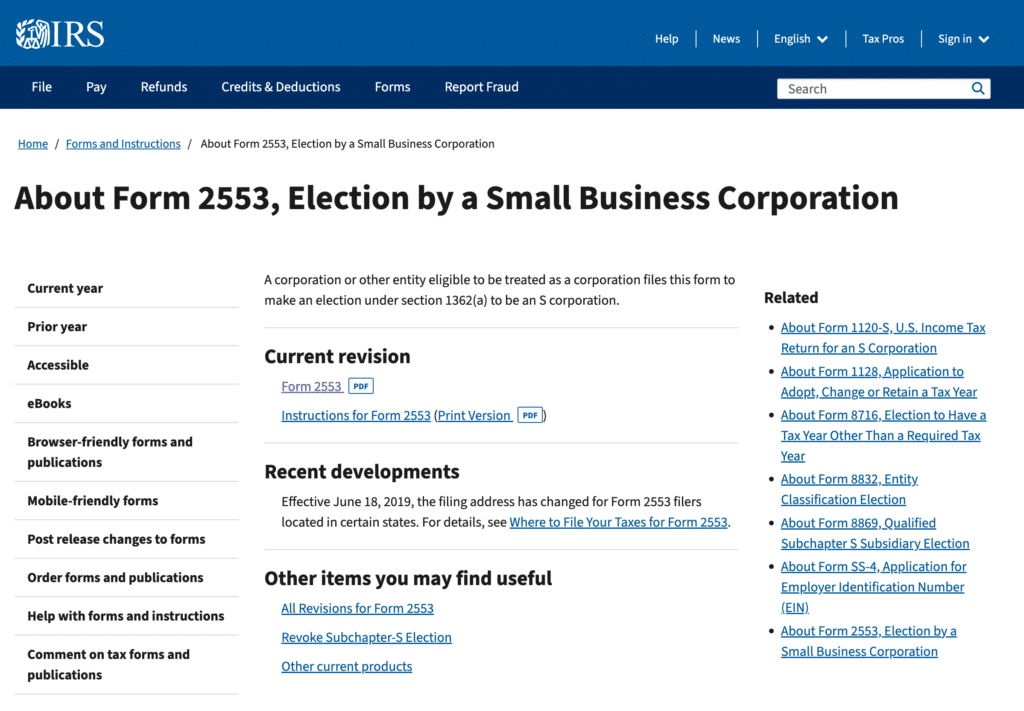
This is the actual election. It’s called Form 2553, Election by a Small Business Corporation. Here’s the form and instructions straight from the IRS. An LLC files Form 2553 to be taxed as an S-Corp (you don’t have to file Form 8832 first, the 2553 handles it).
Watch the deadline. To have the election apply to the current tax year, you generally must file Form 2553 within 2 months and 15 days after the start of that tax year. For a calendar-year business, that’s March 15. Miss it, and the election kicks in next year instead. (The IRS Form 2553 instructions spell out the exact date math.)
Missed the deadline but should’ve elected months ago? There’s late election relief. You can still get it applied retroactively if you had reasonable cause and act within 3 years and 75 days of the effective date. The IRS late election relief page explains it. This is exactly the kind of thing a good accounting firm handles for you.
Step 4: Set up payroll and set your reasonable salary
Once you’re an S-Corp, you’re an employee of your own company. That means you have to run actual payroll: real paychecks, real withholding, real quarterly filings. You’ll pick a payroll provider (we compare Gusto, ADP, and QuickBooks Payroll here) and set your reasonable compensation number.
Step 5: File the S-Corp return every year
An S-Corp files its own tax return, Form 1120-S, every year, separate from your personal return. It produces a Schedule K-1 that flows your profit to your personal 1040. This is an added cost, and it’s part of why the election isn’t worth it at low profit levels.
That’s the whole thing. Five steps. The paperwork is not the hard part. Setting the RIGHT salary and keeping clean books is.
When Does an S-Corp Make Sense for a Contractor?
Short answer: when your net profit is consistently above about $70,000 a year.
Here’s why that number matters. Running an S-Corp costs money: payroll software, an extra tax return, a little more bookkeeping discipline. Below roughly $70K in net profit, those costs eat up the tax savings and you’ve made your life more complicated for nothing.
Above $70K, the math flips in your favor and keeps getting better until your salary approaches the Social Security wage base (more on that below).
The catch is knowing your ACTUAL net profit. Not your revenue, not what’s in your checking account. That’s the number after everything’s paid and your books are reconciled. Most contractors have never looked at it correctly. We walk through exactly how to find it in When Should a Contractor Elect S-Corp? The $70K Net Profit Rule.
What the IRS Requires After You Elect
An S-Corp isn’t “set it and forget it.” Once you’re in, the IRS expects a few things. Blow these off and you can lose the election or get hit at audit.
1. Reasonable compensation
You MUST pay yourself a reasonable salary through payroll. The IRS says shareholder-employees who work in the business have to be paid “reasonable compensation” for their services, and it’s spelled out on the IRS S-Corp compensation page. This is the #1 thing that gets S-Corp owners in trouble. Pay yourself too little to dodge payroll tax, and the IRS will recharacterize your distributions as wages and add penalties. (A CPA named Watson tried paying himself $24,000 while pulling huge distributions. The court bumped his “reasonable” salary to about $93,000 and he owed back taxes on it.)
2. Real payroll and filings
W-2 for yourself. Quarterly payroll tax returns (Form 941). It has to actually happen, and actually get filed. (Side note: we’ve caught QuickBooks Payroll showing “filed” on the dashboard when the returns never went to the IRS. The IRS doesn’t care what your dashboard says.)
3. Clean, reconciled books
You can’t set a defensible salary or file an accurate 1120-S if your books are a mess. Reconciled monthly. Business and personal kept separate. This is table stakes.
We break down the full ongoing requirements, and how to keep them from becoming a headache, in Who Should Help You Elect S-Corp.
The Payroll Tax Deduction Most Contractors Miss
Here’s a bonus nobody mentions. When you run your salary through payroll, that salary (and the employer’s share of the payroll taxes on it) are deductible business expenses to your S-Corp. They lower the profit that flows through to you.
Compare that to a sole prop who writes the IRS a check for income tax. That check buys you exactly ZERO deductions. Paying tax through payroll turns part of the process into a write-off. Same dollars, different tax treatment. We explain this properly in the self-employment tax breakdown.
When an S-Corp Is the WRONG Move
Because we tell the truth even when it costs us a sale:
- You’re under about $70K net profit. The costs outrun the savings.
- You won’t run real payroll. No payroll, no S-Corp. If you’re not willing to do it right, don’t do it.
- You’ve got a complicated ownership mess. Four partners, three entities, a different structure might fit better.
- You’re in a state that taxes S-Corps hard. Some states pile on. California, for example, charges an $800 minimum franchise tax plus a 1.5% tax on S-Corp net income, which can chew into your federal savings. (Level doesn’t take clients operating in California, New York, Oregon, or Hawaii for exactly these kinds of reasons.)
Who Should Actually Set This Up
Not an attorney. We’ll say it louder for the people in the back.
An attorney can form your LLC, sure. But the S-Corp election is a TAX decision. Attorneys know the legal side. They generally don’t do tax strategy, they won’t calculate your reasonable compensation, and they won’t set up or run your payroll. We had a contractor come to us who’d paid an attorney $50,000 to “do their S-Corp.” That work is a few hundred dollars of filing plus ongoing tax strategy. He got fleeced.
The right person is an accounting firm that does construction tax strategy, someone who’ll run the numbers, set your salary, handle the payroll, file the 1120-S, and adjust the whole thing as your profit moves.
Frequently Asked Questions About S-Corps For Contractors
What is an S-Corp and how does it benefit contractors?
An S-Corp is a tax classification that allows profits to be passed directly to shareholders, avoiding double taxation. For contractors, this can result in tax savings and liability protection.
How does an S-Corp differ from an LLC for contractors?
An S-Corp provides potential tax advantages through pass-through taxation, whereas an LLC offers more flexibility in management and fewer formalities. Contractors may choose based on their specific tax and operational needs.
What are the payroll requirements for an S-Corp?
An S-Corp must pay its owner-employee a reasonable salary, which is subject to payroll taxes. Additionally, the S-Corp needs to file payroll tax returns and comply with relevant federal and state payroll regulations.
What constitutes reasonable compensation for an S-Corp owner?
Reasonable compensation for an S-Corp owner should reflect the market rate for the services provided, taking into account factors such as industry standards, experience, and the amount of time dedicated to the business.
When should a contractor file for S-Corp election?
A contractor should file for S-Corp election by March 15 of the tax year in which they wish the election to take effect. However, new businesses can elect S-Corp status at any time during their first tax year.
How does a contractor file for S-Corp status?
A contractor can file for S-Corp status by submitting Form 2553 to the IRS, ensuring all shareholders sign the form. It’s advisable to consult with a tax professional for proper guidance.
What are the tax implications of operating as an S-Corp for contractors?
Operating as an S-Corp allows contractors to avoid double taxation on corporate income, as profits and losses pass through to personal tax returns. This may lower overall tax liability.
Can a contractor convert their LLC to an S-Corp?
Yes, a contractor can convert their LLC to an S-Corp by filing Form 2553 with the IRS and meeting the eligibility requirements for S-Corp status. It’s essential to consult a tax advisor for the best approach.
What are the ongoing compliance requirements for an S-Corp?
An S-Corp must adhere to specific compliance requirements, including filing annual tax returns (Form 1120S), maintaining accurate records, holding regular meetings, and keeping minutes of those meetings.
How much does an S-Corp save a contractor in taxes?
It depends on your profit and your reasonable salary, but contractors in the right range typically save $5,000 to $15,000+ per year in self-employment tax. The savings are biggest between about $70,000 in profit and the Social Security wage base ($184,500 for 2026).
When is the deadline to elect S-Corp status?
For a calendar-year business, you generally must file Form 2553 by March 15 to have it apply to that year. Miss it and it applies next year, unless you qualify for late election relief within 3 years and 75 days.
Do I have to pay myself a salary as an S-Corp?
Yes. The IRS requires shareholder-employees who work in the business to take reasonable compensation through payroll. Skipping it or lowballing it is the fastest way to get audited.
Is an S-Corp worth it under $70K profit?
Usually not. The cost of payroll and a separate S-Corp return tends to cancel out the tax savings below roughly $70,000 in net profit. Above that, it starts paying off.
The Bottom Line
An S-Corp is one of the most effective tax moves a profitable contractor can make, but only when it’s done at the right time, with the right salary, by the right person. The paperwork is easy. Getting the strategy right is where the money is.
If you’re doing $1M+ in revenue and you’ve never had a real conversation about your entity structure, you’re probably overpaying. Book a call at levelaccountingfirm.com and we’ll tell you the truth, even if the truth is “you’re fine where you are.”
Related Posts

When Should a Contractor Elect S-Corp? The $70K Rule

Why Should Contractors Consider an S-Corp Election?

How to Pay Yourself as an S-Corp Owner
Reasonable Compensation for S-Corp Contractors (2026 Guide)

Who Should Help You Elect S-Corp: Accountant or Attorney?