When Should a Contractor Elect S-Corp? The $70K Net Profit Rule
Every contractor who hears about the S-Corp tax savings asks the same next question: “Okay, so should I do it?”
And the honest answer is that it comes down to ONE number. Not your revenue. Not your bank balance. Your net profit.
This article is for contractors trying to figure out if they’re actually ready to elect S-Corp status: HVAC, electrical, plumbing, concrete, pool, fencing, whatever you run. We’ll give you the threshold, show you why it exists, and walk you through how to find your real net profit on your profit and loss report so you’re not guessing.
Key Takeaways
- The rough line is $70,000 in net profit per year. Consistently above it, an S-Corp usually pays off. Below it, the costs eat the savings.
- It’s NET profit, not revenue. A plumber doing $1.5M in revenue with $60K in net profit is NOT ready. A concrete guy doing $600K in revenue with $140K net profit IS.
- The costs of an S-Corp are real. Payroll (roughly $600 to $1,200 a year) and a separate S-Corp tax return (roughly $1,000 to $1,800 a year). That’s the hurdle your savings have to clear.
- You find net profit on your Profit & Loss report, AFTER your books are reconciled. An un-reconciled P&L is a guess, and guessing here can cost you thousands.
- “Consistently” matters. One big year doesn’t mean elect. You want profit that’s reliably above the threshold.
Why $70,000? The Cost-vs-Savings Math
An S-Corp isn’t free to run. Before you save a dime in taxes, you’re taking on:
- Payroll. You have to pay yourself through real payroll. Software runs roughly $600 to $1,200 a year depending on the provider (we break down Gusto vs. ADP vs. QuickBooks Payroll here).
- A separate tax return. An S-Corp files its own return, Form 1120-S, every year on top of your personal return. Figure another $1,000 to $1,800 in prep.
- Tighter bookkeeping. Nothing crazy, but your books have to actually be clean to set a defensible salary and file accurately.
Call it $2,000 to $3,000 a year in added cost, ballpark.
So the question is simple. Does the self-employment tax you’d save beat that $2,000 to $3,000?
Below about $70,000 in net profit, usually no. The savings are thin and the added complexity isn’t worth it. Right around $70K, you’re at break-even to modestly ahead. Once you’re clearly past it, you win, and you keep winning every single year.
Here’s roughly how it scales (illustrative, since your real numbers depend on your reasonable salary):
| Net profit | Rough annual SE tax savings | Worth it? |
|---|---|---|
| $50,000 | ~$0 to $1,500 (costs eat it) | No |
| $70,000 | ~$1,500 to $2,500 | Break-even / maybe |
| $120,000 | ~$4,000 to $6,000 | Yes |
| $200,000 | ~$9,000 to $11,000 | Absolutely |
Want the actual worked-out tax math behind those numbers? It’s in How S-Corps Cut Your Self-Employment Tax.
Revenue Is Not Profit (and This Trips Up Everybody)
This is where contractors get it wrong constantly.
A plumbing company doing $1.5M in revenue sounds huge. But if after crews, materials, trucks, insurance, supply house bills, and overhead there’s only $60,000 left, that business is NOT a slam-dunk S-Corp yet.
Meanwhile a concrete guy doing $600K in revenue who’s running lean and clears $140,000 in net profit absolutely should be looking at it.
Big revenue, thin margins is extremely common in construction. About 70% of contractors deal with payment delays past 30 days, and margins get squeezed everywhere. Revenue tells you how much money moves THROUGH your business. Net profit tells you how much actually STAYS. The S-Corp decision only cares about what stays.
Click here for the IRS Guide on Self-Employment Tax.
How to Find Your Real Net Profit (Read Your P&L)
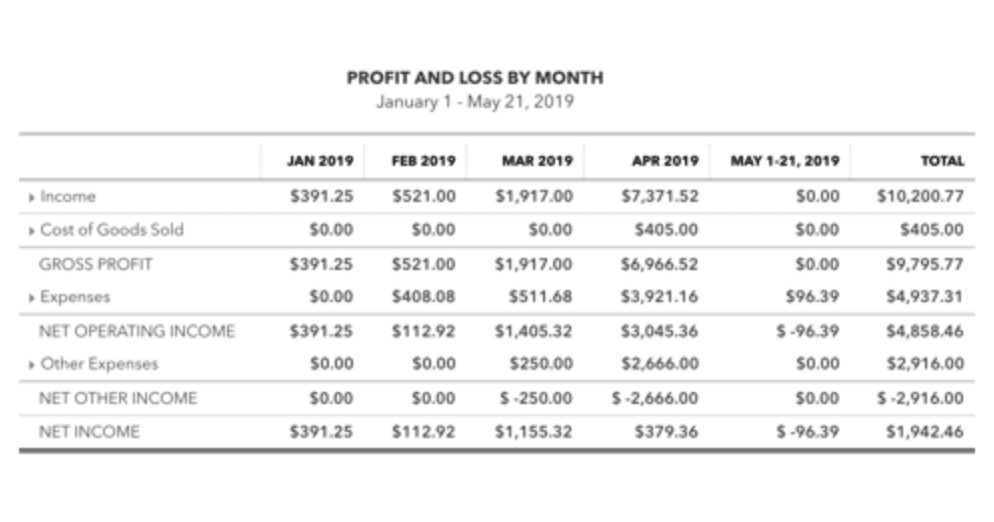
Your net profit lives on one report: the Profit & Loss statement (also called the income statement or “P&L”). Here’s how to read it without an accounting degree.
A P&L is basically a stack that subtracts its way down to one number at the bottom:
- Revenue (Income). Everything you billed and collected. Top line.
- Minus Cost of Goods Sold (COGS). The direct cost of doing the work: materials, subs, direct labor, equipment rental on jobs. This leaves Gross Profit.
- Minus Operating Expenses (Overhead). The stuff that runs the business whether or not you’re on a job: office, software, insurance, admin pay, marketing, your truck, accounting fees.
- Equals Net Profit (Net Income). The bottom line. THIS is your number.
That bottom-line net income is what you compare to the $70K threshold. Not the top line. The bottom line.
Don’t have up-to-date books? No problem, we help contractors get caught up and elect s-corp. Check out our bookkeeping page here to see how it works.
The step everyone skips: reconcile FIRST
Here’s the part that matters, and it’s the reason we harp on it: an un-reconciled P&L is fiction.
Reconciling means matching every transaction in your books against your actual bank and credit card statements, so you KNOW the numbers are real and complete. If you haven’t reconciled:
- Expenses might be missing (so your profit looks HIGHER than it is, and you elect too early).
- Personal expenses might be mixed in (so your profit looks LOWER than it is, and you skip a move that would’ve saved you $8K).
- Duplicate or miscategorized transactions throw the whole thing off.
Running the S-Corp decision off books that aren’t reconciled is like measuring a job with a tape measure you know is bent. Reconcile monthly, keep business and personal completely separate, THEN pull the P&L. Now the net profit number means something.
If your books aren’t in a state where you’d trust that bottom-line number, that’s problem #1, before the S-Corp question even comes up.
Before You Elect S-Corp…
One monster year doesn’t automatically mean elect. You cleared $90K this year after three years at $45K? Great year. But don’t restructure your whole tax situation off a spike.
What you’re looking for is net profit that’s reliably above the threshold. If you’ve been climbing and you’re now steadily clearing $70K, $90K, $120K, that’s the signal. This is exactly why proactive tax planning beats once-a-year filing. Someone should be watching your profit trend and telling you the year it makes sense to pull the trigger, not discovering it 14 months too late.
So… Are You Ready to Elect S-Corp?
Quick gut check:
- ✅ Net profit consistently above about $70K?
- ✅ Books actually reconciled, so you TRUST that number?
- ✅ Willing to run real payroll?
- ✅ Not tangled up in a weird multi-partner ownership mess?
Four yeses and you’re very likely leaving money on the table by staying a sole prop or plain LLC. For the full picture on how the election works start to finish, see the pillar: S-Corp for Contractors: The Complete Guide.
Frequently Asked Questions
How much profit should I have before electing S-Corp?
As a rule of thumb, about $70,000 in net profit per year, consistently. Below that, the cost of payroll and a separate S-Corp tax return usually cancels out the self-employment tax savings. Above it, the election starts paying for itself.
Is S-Corp Election Based on Revenue or Profit?
Net profit, the bottom line of your Profit & Loss statement, after all costs. Revenue (your top line) doesn’t matter for this decision. Plenty of high-revenue contractors have thin profit and aren’t ready.
Where do I find my net profit?
On your Profit & Loss statement, at the very bottom (net income). Make sure your books are reconciled first. An un-reconciled P&L will give you a wrong number and a wrong decision.
Should I elect S-Corp because I made more money this year?
Don’t restructure off a single spike. You want net profit that’s reliably above the threshold, not one good year followed by lean ones. This is where a tax planner watching your trend earns their keep.
The Bottom Line
The S-Corp decision comes down to one honest number, your consistent net profit, and whether it clears the roughly $70K bar after the costs of running the election. Find that number the right way (reconciled books, bottom of the P&L) and the decision usually makes itself.
Not sure what your real net profit is, or whether it’s steady enough? That’s literally what we do. Book a call at levelaccountingfirm.com and we’ll pull the actual number and tell you if it’s time.