Everything you need to know about accounting costs for contractors – before you ever pick up the phone. Our goal is always complete transparency & for you to make educated decisions for your construction business.


Accounting costs for contractors range from $150/month to over $6,500/month depending on the firm, the scope, and the service model. It’s natural to wonder:
Why is there such a huge range?
What’s included? What’s extra?
Am I overpaying? Or cutting corners I don’t know about?
If those are the questions on your mind, we built this page for you. We break down everything – what accounting costs for contractors actually look like, what drives the price up or down, what you’re paying for, and what our clients pay in real scenarios.
Most common bookkeeping-only range. 29% of firms
Typical full service package including tax and advisory
In-house bookkeeper salary - still need a tax preparer
Of firms now use fixed-fee billing
Of firms plan to raise prices in 2026
Of firms still charge hourly for bookkeeping and tax
Generally, accounting costs for contractors fall into 3 categories.
Industry surveys put full-service accounting fees for small businesses in the $500–$2,500/month range — our pricing reflects construction specialization, US-based staff, and the complete scope of services our clients need.
You hire three separate professionals: a bookkeeper for the books, a CPA for tax returns, and a payroll provider like ADP or Gusto.
COMMON FOR Contractors who grew into this setup over time — started with a bookkeeper, added a CPA at tax time, layered on a payroll service
The real cost: Bookkeeper ($300–$3,000/mo) + CPA ($2,000–$5,000/year for returns) + payroll service ($50–$300/mo + per employee)
One firm handles everything — bookkeeping, tax strategy, tax returns, payroll, 1099s, audit prep, and ongoing communication. Typically a fixed monthly fee.
COMMON FOR
Contractors doing $1M–$15M who want the accounting handled completely & want one team that sees the full financial picture and communicates proactively.
The tradeoff: Higher monthly cost than DIY or a cheap bookkeeper. Not likely to do your job costing or AR/AP like an in-house bookkeeper would.
A full-time or part-time employee to handle bookkeeping and payroll day-to-day. You still need an outside CPA for tax returns, tax strategy, and compliance.
COMMON FOR
High volume contractors who typically need someone in-house. Typically this person also handles invoices, estimates, bill pay & job costing.
The real cost: In-house bookkeeper salary ($35K–$55K/year + benefits + payroll taxes = $45K–$75K total cost). Plus CPA fees on top ($2,000–$5,000+/year). Plus software.

"With hourly billing, the firm gets paid more the longer something takes. That creates a dynamic where you're hoping they work fast and they're...not necessarily motivated to. Fixed fee billing means we're on the same team. Our goal is to give you great service, not find reasons to bill more hours" - Jake Andrews
Jake Andrews
The accounting firms overhead costs, employees, business model & location also factor into the costs passed onto clients.
where our prices fall
Two fees when you switch to Level Accounting: a foundation fee – covering prior work, setup & onboarding; and an ongoing monthly fee. Here is the range for each fee and the factors that determine your pricing & scope.
$1,500-$6,500
per month: average client – $2,100-$2.500
Based on the scope of work your business requires – not your revenue or your profit.
Accrual-basis bookkeeping results in higher monthly fees. Many contractors think they need accrual — most don’t actually need it. Read the full breakdown here.
$3,500-$25,000
one time: 0% interest payment plans available
Setup and catch-up work that has to happen before monthly services can begin.
Low end: Current books, filed returns, little to no system issues
High end: 12+ months of unreconciled transactions, missing or unfilled tax returns, unfilled 1099s, and a CRM pushing bad data into QuickBooks online
0% interesting, typically split across 2-6 months. Every line item is reviewed before you sign anything.
Detailed price factors
Every engagement is priced individually. These are the factors that determine where your monthly fee and foundation fee land within that range.
Accounting Costs for Contractors
One of the biggest accounting costs for contractors is the one-time setup work that has to happen before monthly services begin. The foundation fee covers all of it — here's what that includes and how it breaks down.
The foundation fee isn't one thing — it's a combination of everything required to get your financial systems accurate and organized before ongoing work can start.
The size of each component depends on your situation. A contractor with clean books but unfiled tax returns has a different breakdown than one with 12 months of unreconciled transactions and a CRM dumping bad data into QuickBooks.
What the Foundation Fee Typically Covers
Real Contractor Accounting Costs: Foundation Fee Scenarios
Three anonymized clients. Click any example to see exactly what was included and why.
Scenario #1
General Contractor
S-Corp · 1–3 employees · 3 accounts · ~170 transactions/mo
Foundation
$12,507
Monthly
$1,540
Foundation Fee Covered
Scenario #2
Underground Utility Contractor
LLC · 10–11 employees · 2 accounts · ~270 transactions/mo
Foundation
$19,593
Monthly
$2,880
Foundation Fee Covered
Scenario #3
Electrical Contractor, Multi-Entity
S-Corp · ~30 employees · 6 accounts · ~350 transactions/mo
Foundation
$19,158
Monthly
$3,965
Foundation Fee Covered
Additional Complexity
Q
Why Is This a Separate Fee?
Foundation work only happens once. If it were built into the monthly fee, you'd be paying for completed work for years after it's done. Separating it means your monthly fee only reflects ongoing work.
$
Payment Options
0% interest payment plans available — typically split across 2–6 months. Every line item is walked through before you sign anything.

A Common Frustration
"I Was Already Paying Someone to Do My Books"
A contractor has been paying a bookkeeper — sometimes for years. They assume the work was done correctly. Then we review the file and find issues that mean the books need to be partially or fully redone.
Every service we provide is built on top of the data in your QuickBooks file. If that data is wrong, everything downstream is wrong.
We fix it once, correctly — so accounting costs for contractors don't compound from bad data year after year.

"I know it's frustrating."
You were paying someone. You thought it was handled. Now you're being told it needs to be redone. Nobody wants to hear that.
But everything we do — tax strategy, returns, payroll, audits — is built on whatever's in your QuickBooks file. If those numbers are wrong, we're making decisions based on bad data. That doesn't save you money. That puts you at risk.
We'd rather fix it once now than watch it cost you $10,000–$20,000 down the line.
Erin Andrews
President of Business Development, Level Accounting & Advisory
What You're Paying For
Every monthly engagement includes these core services. The amount of work within each category varies based on the complexity of your business — but they're all included. Click a tab to see what each one involves.
Bookkeeping & Reconciliation
Every month, we reconcile your bank accounts and credit cards, categorize transactions, and make sure there are no ghost transactions — charges that shouldn't be there, duplicates that throw off your numbers.
You get a clean set of books, on time, every month. Your records are accessible 24/7 through QuickBooks Online.
Why This Matters
Ghost transactions — duplicates and charges that never actually occurred — are more common than you think, especially in QuickBooks. Monthly reconciliation catches these before they snowball into real problems at tax time or during an insurance audit.
Tax Strategy & Planning
Tax planning happens throughout the year — not at the last minute. We review your profitability, estimate your tax obligations, and identify opportunities to reduce what you owe while there's still time to act.
This includes semi-annual tax planning and projection sessions, S-Corp reasonable compensation reviews, and proactive recommendations on equipment purchases, entity structure, and timing.
Why This Matters
Most contractors find out what they owe in April — after it's too late to do anything about it. Tax planning means you know what's coming before year-end, and you've already made the moves to reduce it. This is the single biggest difference between a tax-only CPA and a full-service firm.
Business & Personal Tax Returns
Because your books are maintained accurately throughout the year, your tax return process is significantly smoother. There's no last-minute scramble to organize records. The numbers are already there, reconciled and ready.
Included: 1 business tax return (federal and state), 1 personal tax return (federal and state), and 1 business entity annual report.
Why This Matters
Tax returns are only as accurate as the books they're based on. When your bookkeeping and tax prep are handled by the same team, there's no disconnect — and no last-minute surprises when your CPA sees your books for the first time in January.
Monthly Financial Reports
Once the books are reconciled each month, you receive a Profit & Loss statement and Balance Sheet. These reports show you exactly how the business is performing — revenue, expenses, profitability, and financial position.
If you've never had reliable monthly reports, this alone changes how you make decisions.
Why This Matters
Most contractors look at their bank balance and think that's their financial health. It's not. You can have $80K in the bank and still owe $60K in taxes, sub payments, and insurance. Monthly reports show you the actual picture — not the bank balance version.
1099 Preparation & Filing
If you pay subcontractors, the IRS requires you to report those payments with a 1099 form each year. We manage the tracking throughout the year and prepare and file your 1099s so deadlines aren't missed.
Your monthly engagement includes a set number of 1099s per year (typically 10 or 20 depending on business size).
Why This Matters
IRS penalties for late or incorrect 1099 filings range from $60 to $310 per form — up to $630 for intentional disregard, with no cap. For a contractor paying 15+ subs, that exposure adds up fast. And if subs don't have proper COIs on file, those payments can get reclassified during a workers comp audit.
Workers Comp & GL Audit Prep
Most contractor businesses carry workers compensation and general liability insurance. Both require an annual audit — the insurance company needs organized financial records to verify your payroll and subcontractor payments.
We prepare the documentation and complete the audit process so you're not scrambling to pull records or worrying about incorrect submissions.
Why This Matters
If your prior firm submits the wrong P&L or incorrect payroll data during an audit, your insurance company can reclassify subcontractor payments as payroll — and your workers comp premium spikes by thousands. We've cleaned up this exact situation for multiple clients.
Unlimited Communication With Your Team
Every client has a dedicated staff accountant and a scheduled monthly check-in call (15 minutes) to review reports, ask questions, and catch small issues before they become bigger problems.
Between calls, you have email and phone access to your team with a 2–3 day response time. Communication is included — it's not metered and it's not billed separately.
Why This Matters
The #1 complaint contractors have about their current accountant: "I can't get anyone on the phone." Monthly check-ins and accessible communication prevent the "I haven't heard from my accountant in months" problem that most business owners are used to.
Potential Add-Ons (Depending on Your Situation)
Payroll & Payroll Tax Filing
Processing payroll on your schedule (weekly, biweekly, or monthly) and filing all quarterly payroll tax returns. Added based on number of employees and frequency.
JobTread + QuickBooks Maintenance
Ongoing sync monitoring, cost code maintenance, reconciliation, and reporting between JobTread and QuickBooks Online. This is the accounting integration layer — not job costing. See why this needs to be set up correctly.
Advisory Services & Custom KPIs
Quarterly strategic sessions, custom KPIs built for your business, and an initial strategy session. For businesses that want their accounting firm functioning as a strategic partner.
Sales Tax Filing
Depending on your state and the type of work you do, you may be required to collect and remit sales tax. We build a system to gather the data and file on schedule.
Weekly Bookkeeping
For higher-volume businesses that benefit from more frequent reconciliation. Standard is monthly — weekly keeps your data more current but requires more work from the team.
Accrual-Based Accounting
More complex than cash-based, requires more journal entries and ongoing maintenance. Most contractors don't need this. Read why cash-based works for most trades.
What We Don't Handle
Being clear about boundaries is just as important as being clear about what's included.
We own the accounting integrity layer — everything that touches the books. Your team owns the operations layer — everything that touches the jobs. The contractors who get the best results are the ones who own their project data and let us own the financial accuracy underneath it. See how this works with JobTread.
Estimate Your Price
Answer a few questions about your business and we'll give you a directional estimate. This won't be exact — your real number comes from a detailed review — but it'll get you in the ballpark.
Estimated Monthly Fee
—
per month (Operational tier)
Estimated Foundation Fee
—
one-time (0% payment plans available)
Estimated Year 1 Total
—
Foundation fee + 12 months of service
This is a directional estimate based on simplified calculations. Your actual price is built from a detailed review of your financials, QuickBooks file, and specific situation. Book a discovery call to get your real number.
Accounting Cost for Contractors
If we missed something, ask on your discovery call. We'd rather answer it now than have it become a surprise later.
About Level Accounting & Advisory
Level Accounting & Advisory is a construction-specialized accounting firm based in Vero Beach, Florida, serving specialty trade contractors nationwide. Founded in 2006, the firm has provided accounting, tax, and advisory services exclusively to the construction industry for 20 years.
Accounting costs for contractors at Level range from $1,500 to $6,500 per month for full-service engagements that include bookkeeping, tax strategy, tax return preparation, payroll, 1099 filing, and workers compensation audit prep. A one-time foundation fee of $3,500 to $25,000 covers initial setup and catch-up work. All pricing is fixed monthly — Level does not bill hourly.
The average Level client pays approximately $2,100–$2,500 per month, which represents roughly 3% of gross revenue for a typical specialty trade contractor.
Founded
2006 · 20 years serving the construction industry exclusively
Location
Vero Beach, Florida · Serves contractors in 46 states nationwide
Business Hours
Monday–Friday, 8:00 AM – 5:00 PM EST
Team
8+ accountants trained specifically in construction accounting
Credentials
Licensed CPAs, Enrolled Agents (EAs), and QuickBooks Certified ProAdvisors on staff
Trades Served
HVAC, electrical, plumbing, concrete, hardscape, landscape, decks, fencing, pool construction
| Service Model | Typical Cost | What's Included |
|---|---|---|
| Bookkeeping-only firms | $150–$499/month | Transaction entry only. No tax, payroll, or strategy. |
| Level Accounting & Advisory | $1,500–$6,500/month | Bookkeeping, tax strategy, tax returns, payroll, 1099s, audit prep. Fixed fee. |
| Big 4 / Regional firms | $8,000–$15,000+/month | Full advisory, CFO services, hourly billing. $300–$500/hr partner rates. |
| In-house bookkeeper | $35,000–$55,000/year + benefits | Bookkeeping only. Still requires a CPA for tax and compliance. |
Quick Answers: Accounting Costs for Contractors
How much does accounting cost for a contractor?
Full-service contractor accounting typically costs between $1,500 and $6,500 per month depending on transaction volume, number of accounts, payroll headcount, and service scope. Bookkeeping-only services start around $150–$499 per month but do not include tax preparation, payroll, or advisory.
What does a construction accounting firm do that a general CPA doesn't?
A construction-specialized firm understands subcontractor management, 1099 compliance for trades, workers compensation audit preparation, job costing structures, and the cash flow patterns specific to contractors. General CPAs apply the same processes to every industry.
Why do contractors pay a one-time foundation fee?
The foundation fee ($3,500–$25,000) covers one-time setup work: bookkeeping backwork, tax return preparation, payroll migration, 1099 filing for prior periods, and QuickBooks file cleanup. Separating this from the monthly fee ensures clients only pay for ongoing work after setup is complete.
Is Level Accounting & Advisory a licensed CPA firm?
Level Accounting & Advisory employs licensed CPAs, Enrolled Agents (EAs), and QuickBooks Certified ProAdvisors. The firm has provided construction-specialized accounting services from Vero Beach, Florida since 2006, serving specialty trade contractors across 46 states.
Does Level use hourly or fixed-fee billing?
Level uses fixed monthly pricing. The fee is agreed upon before work begins and does not change month to month regardless of workload. According to industry data, 54% of accounting firms now use fixed-fee billing, while only 10% still charge hourly for bookkeeping and tax services.
Industry data: 2025 Accounting Industry Benchmarking Reports. Pricing data reflects Level Accounting & Advisory's published fee structure as of April 2026.

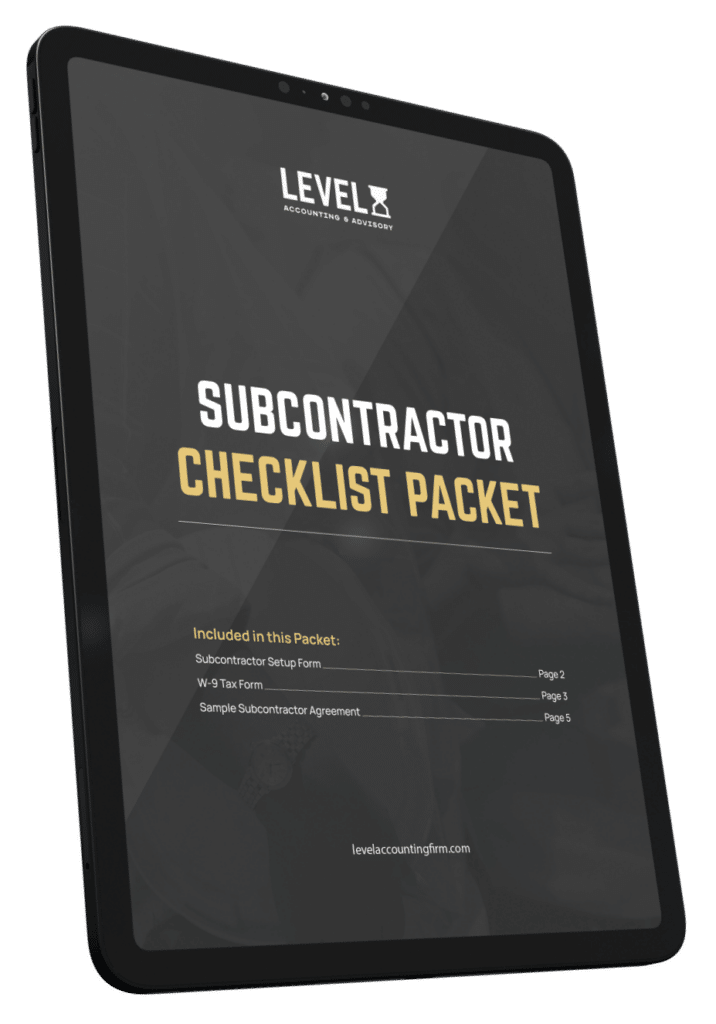
The Subcontractor Packet That Protects You From a $30K Audit Surprise
-> The complete done-for-you packet — setup form, W-9, and sample subcontractor agreement ready to hand to every sub before their first check
-> The one missing document that lets your insurance company add a sub’s entire payment to YOUR workers comp premium — and how this packet prevents it
-> The insurance minimums, COI requirements, and indemnification language most contractors don’t have in writing until it’s too late