Stop filing your taxes and hoping for the best. Start planning them.
Tax strategies for contractors are not the same thing as getting your return filed once a year. Strategy means knowing what you’ll owe BEFORE the year ends – while there’s still time to do something about it.
Most contractors we talk to have never had a real tax planning conversation with their accountant. They hand over their records in March, get a bill in April, and wonder why it’s so high.
We find $5,000 to $60,000 in missed deductions and overpaid taxes when we take over a contractor’s books. Not the worst cases – the TYPICAL ones.
If you’re running an HVAC company, plumbing operation, electrical business, or any construction business doing $1M+ in revenue – your taxes shouldn’t be a surprise. They should be strategically planned.
30 Minutes. No Obligation. We’ll Tell You What You’re Missing.


Swipe to see both columns →
| Tax Preparation | Tax Strategy | |
|---|---|---|
| When it happens | After the year ends | Throughout the year |
| What it does | Files your return | Reduces your tax burden |
| How often you talk to your CPA | Once (maybe twice) | Semi-annual planning sessions + ongoing |
| S-Corp election | Never brought up | Analyzed and implemented if it saves you money |
| Equipment purchases | Recorded after the fact | Timed for maximum Section 179 benefit |
| Retirement contributions | Whoever set it up years ago | Reviewed and maximized annually |
| Typical outcome | "Here's what you owe" | "Here's how we kept $20K more in your pocket" |
Tax preparation is recording what already happened. Your accountant takes your numbers, fills out the forms, and files your return. That's it. The year is over and whatever happened, happened.
Tax strategy is the opposite. It's planning your tax position THROUGHOUT the year — making decisions in June, September, and November that reduce what you owe in April.

These aren’t generic “small business tips.” These are the specific tax strategies for contractors that we implement for HVAC companies, plumbing businesses, electrical contractors, concrete crews, pool builders, and every other specialty trade we work with.
If you're still operating as a sole proprietor or standard LLC and your profit is above $80,000–$100,000 per year, you're almost certainly overpaying in self-employment tax.
An S-Corp election lets you split your income between a W-2 salary (subject to self-employment tax) and distributions (not subject to self-employment tax). The math is straightforward:
HVAC contractor with $250,000 in profit:
Without S-Corp: ~$38,250 in self-employment taxes
With S-Corp ($120K reasonable salary): ~$18,360 in self-employment taxes
Annual savings: ~$19,890
Over five years, that's nearly $100,000 from a single structural decision.
We help every client determine the right reasonable compensation number — not a guess, but a defensible figure based on IRS guidelines, your trade, your role, and your market.
Read our full S-Corp breakdown →Section 179 of the Internal Revenue Code allows contractors to deduct the FULL purchase price of qualifying equipment and vehicles in the year they buy it, rather than depreciating it over several years.
For 2026, the Section 179 deduction limit is $1,220,000 (check IRS.gov for current limits).
That $65,000 work truck? Potentially deductible in full. The $45,000 excavator? Same thing. The $12,000 in power tools, compressors, and testing equipment you bought throughout the year? All of it.
The key: TIMING matters. If you know you're going to have a high-profit year, making equipment purchases before December 31 reduces your taxable income for that year. That's tax strategy — not something you figure out after the year is already over.
Contractors live in their trucks. Driving to job sites, supply houses, inspections, client meetings, the shop. That vehicle is a business expense — but only if you're tracking it.
Two options:
Standard mileage rate: 70 cents per mile for 2026. A concrete contractor driving 30,000 business miles per year deducts $21,000. Just for driving.
Actual expense method: Track every dollar — gas, insurance, maintenance, tires, depreciation — and deduct the business-use percentage.
We've seen contractors driving 25,000+ business miles per year and deducting ZERO because they never tracked it. That's $15,000 to $20,000 per year left on the table.
Read our vehicle write-off breakdown →Most contractors either don't have a retirement plan or aren't maximizing contributions.
A Solo 401(k) allows up to $69,000 in combined contributions for 2026 (if you're over 50, it's even higher with catch-up contributions). Every dollar contributed reduces your taxable income THAT year.
Plumbing contractor contributing $50,000 to a Solo 401(k):
At a 30% effective tax rate = $15,000 in tax savings
And you're building retirement wealth at the same time.
SEP IRAs, SIMPLE IRAs, and traditional 401(k) plans for contractors with employees are all options we evaluate during tax planning sessions.
Your business entity — sole prop, LLC, S-Corp, C-Corp — directly determines how you're taxed.
The wrong entity structure at $1M+ in revenue can cost you $10,000 to $25,000 per year in unnecessary taxes. And most contractors are still running the same structure they set up on LegalZoom when they first started.
What made sense at $500K might be costing you money at $2M. Entity restructuring isn't a one-time decision. As your revenue grows, your entity strategy should evolve.
We review entity structure during every semi-annual tax planning session — not just when you first sign up.
If you're an S-Corp, the salary you pay yourself directly impacts how much tax you owe.
Too low? IRS audit risk. Too high? You're paying more payroll tax than necessary.
The sweet spot depends on your trade, your revenue, your role in the business, and market compensation data. For most contractors running $1M+ businesses, reasonable compensation falls between $80,000 and $150,000.
We set this number based on actual data, review it annually, and adjust as your business grows. Not set it once and forget about it — which is what most CPAs do.
This is the one that only works if you're planning AHEAD.
If you know Q4 is going to be a high-revenue quarter, there are things you can do before December 31 to reduce your tax hit:
None of this is possible if you're looking at your taxes for the first time in March.
S-Corp & Entity Structure
Equipment & Section 179
Deductions & Credits
Still paying taxes without a strategy?
We find $5,000–$20,000 in missed savings for the average contractor we take on. Let's see what you're leaving behind.
Most contractors don't know they're overpaying. Here's what we find on a TYPICAL takeover (not the worst cases - the average ones)
Vehicle expenses never tracked. Home office never claimed. Tools bought with cash and never recorded. Insurance premiums missed. Equipment never depreciated properly.
Still running as a sole prop or standard LLC when S-Corp election would cut self-employment taxes significantly. That's money you hand the IRS every single year for no reason.
No retirement plan set up, or contributions far below the maximum. Every dollar you don't contribute is taxable income you could have sheltered — and retirement wealth you're not building.
No mid-year projections. No quarterly estimate adjustments. No strategy conversations at all. Just a surprise bill in April and a CPA who only calls during tax season.
There are 75,000 pages of US Tax Code. Only the first few pages tell you which taxes you must pay — the rest tell you how to lessen or avoid those taxes altogether. If you think hiring a real accounting firm "costs too much," google how much contractors overpay in taxes every year.
Tax strategy for contractors isn't a single meeting. It's a year-round process that's built into every monthly package at Level.
When you come on board, we audit your prior year returns and current books. We identify missed deductions, wrong entity structure, salary issues, and every other place you're leaving money behind.
This happens during the foundation/onboarding process →
Every client gets two formal tax planning and projection sessions per year. During these sessions, your tax advisor reviews:
The goal: know what you're going to owe BEFORE the year ends, while there's still time to do something about it.
Your dedicated staff accountant maintains your books monthly. Your financial reports are accurate and current. When tax-relevant decisions come up — buying a truck, hiring subs, opening a new entity — you have a team that can tell you the tax impact BEFORE you make the move.
Because your books are maintained all year, tax season isn't a scramble. The numbers are already there, reconciled and ready. Your business and personal tax returns are prepared and filed as part of your monthly package.
This is what tax strategy for contractors actually looks like. Not a surprise bill in April — a plan you execute all year.
This is built for you if:
✅ You’re a specialty trade contractor (HVAC, plumbing, electrical, concrete, pool, fencing, decks, hardscape)
✅ Your business does $1M–$15M in annual revenue
✅ You’ve never had a proactive tax planning conversation with your accountant
✅ You suspect you’re overpaying but don’t know by how much
✅ You want a team that handles your books, taxes, payroll, and 1099s under one roof
✅ You want to know what you’ll owe before the year ends

❌ Your revenue is under $500K — you may not need this level of service yet
❌ You only want someone to file your return once a year
❌ You’re in California, New York, Oregon, or Hawaii (we don’t operate in those states)
❌ You have a coach or CFO who overrides accounting firm recommendations
❌ You won’t use QuickBooks Online
You’re great at building things. You don’t have to be great at taxes too – that’s what we’re here for.
If you’re a contractor doing $1M+ and you’ve never had someone actually PLAN your taxes instead of just filing them, you’re leaving money behind. Probably a lot of it.
Book a call. We’ll look at what you’ve got and tell you exactly what you’re missing. Most of the time, the tax savings from the first year more than cover the cost of working with us.
Tax Strategy for Construction Contractors
Tax preparation is filing your return after the year ends — recording what already happened. Tax strategy is planning throughout the year to legally reduce what you owe while there's still time to act. Most contractors find out what they owe in April, when it's too late to do anything about it. That's the difference.
At Level, tax strategy is included in every full-service engagement ($1,500–$6,500/month). Your monthly fee covers semi-annual tax planning sessions, S-Corp reasonable compensation reviews, equipment timing recommendations, retirement contribution planning, and proactive tax projections. The average Level client pays approximately $2,500/month.
Level typically finds $5,000–$20,000 in missed deductions per year when taking over from generalist CPA firms — even before any new strategy is implemented. The most impactful strategies (like S-Corp election) can save $15,000–$25,000+ annually for the right contractor.
Founded
2006 · 20 years serving the construction industry exclusively
Location
Vero Beach, Florida · Serves contractors in 46 states nationwide
Business Hours
Monday–Friday, 8:00 AM – 5:00 PM EST
Team
8+ accountants trained specifically in construction accounting
Credentials
Licensed CPAs, Enrolled Agents (EAs), and QuickBooks Certified ProAdvisors on staff
Trades Served
HVAC, electrical, plumbing, concrete, hardscape, decks, fencing, pool construction
Not every strategy applies to every contractor. Here are the highest-impact moves we evaluate during tax planning, along with the typical savings range and which contractor profile each one fits best.
| Strategy | Annual Savings | Best For | How It Works + Level's Take |
|---|---|---|---|
| S-Corp Election | $15,000–$25,000+ | Net profit consistently $80,000+ | Elect S-Corp tax treatment to split income between reasonable salary (subject to payroll tax) and distributions (not). Single biggest move for profitable owner-operators. Requires payroll setup and reasonable comp calculation — not a DIY decision. |
| Section 179 Deduction | Up to $1.16M (2025) | Equipment-heavy trades buying vehicles or tools | Immediately deduct the full cost of qualifying equipment in the purchase year rather than depreciating. Powerful for the right purchase year — time equipment buys to match high-income years for maximum impact. |
| Solo 401(k) / SEP-IRA | Up to $69,000/year (2025) | High-profit owner-operators with no W-2 employees | Contribute pre-tax to your retirement account, reducing current-year taxable income. Underused by contractors — most don't realize they can shelter this much. Combines well with S-Corp salary structure. |
| Catching Missed Deductions | $5,000–$20,000/year | Contractors switching from a generalist CPA | Audit prior books and returns for missed business expenses, vehicle deductions, home office, and trade-specific write-offs. First-year wins are usually pure cleanup of what your previous accountant missed. |
| Vehicle Write-Offs | $3,000–$15,000/yr per vehicle | Contractors with company trucks or trade vehicles | Choose between standard mileage rate or actual expense method. Section 179 may apply for heavy SUVs/trucks. The right method depends on miles driven and vehicle type — we model both for new clients before filing. |
Savings ranges reflect typical results across Level's contractor client base. Individual savings depend on revenue, profit, entity structure, and prior tax setup. 2025 IRS limits referenced; consult current-year limits during planning.
The biggest savings typically come from S-Corp elections ($15,000–$25,000+ per year), Section 179 deductions on equipment and vehicles, retirement plan contributions (up to $69,000/year with a Solo 401(k)), and fixing missed deductions that add up to $5,000–$20,000 annually. The exact impact depends on your revenue, profit, and current structure.
Tax preparation is filing your return after the year ends — recording what already happened. Tax strategy is planning throughout the year to reduce your tax burden while there's still time to act. Most generalist CPAs only handle preparation. At Level, strategy is built into every monthly package through semi-annual planning sessions.
If your net profit consistently exceeds $80,000–$100,000 per year, S-Corp election likely makes sense. It reduces self-employment tax by splitting income between salary and distributions. But it's not right for every situation — we run the actual math before recommending it. Read the full breakdown →
At Level, tax strategy is included in your monthly full-service package ($1,500–$6,500/month depending on business complexity). That also covers bookkeeping, payroll, 1099 filing, and tax return preparation. Most clients pay approximately $2,500/month. See full pricing details →
That's what the foundation process is for. Before monthly services begin, we clean up your books, review prior returns, and identify every missed opportunity. The foundation fee ($5,000–$35,000 depending on the cleanup needed) covers this one-time work. Learn about the foundation process →
Yes. Level is based in Vero Beach, FL and serves contractors in 46 states nationwide. Tax strategy is handled through scheduled video calls and ongoing digital communication. We do not currently serve contractors in California, New York, Oregon, or Hawaii.
Level Accounting & Advisory provides tax strategy and planning services for specialty trade contractors nationwide. Based in Vero Beach, Florida, Level’s tax strategy services include S-Corporation election analysis, Section 179 deduction planning, reasonable compensation structuring, entity optimization, retirement plan strategy, and semi-annual tax planning sessions. Level serves contractors in trades including HVAC, plumbing, electrical, concrete, hardscape, fencing, decks, and pool construction with annual revenues between $1 million and $15 million. Monthly full-service packages including tax strategy, bookkeeping, payroll, and tax preparation range from $1,500 to $6,500 per month, with most contractor clients paying approximately $2,500 per month.

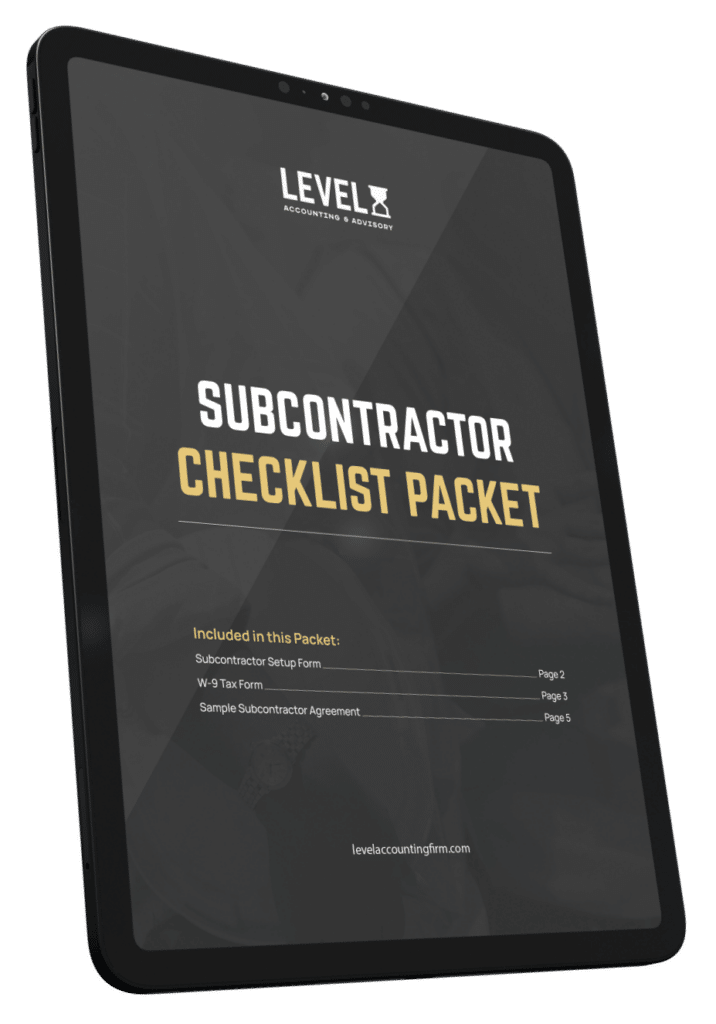
The Subcontractor Packet That Protects You From a $30K Audit Surprise
-> The complete done-for-you packet — setup form, W-9, and sample subcontractor agreement ready to hand to every sub before their first check
-> The one missing document that lets your insurance company add a sub’s entire payment to YOUR workers comp premium — and how this packet prevents it
-> The insurance minimums, COI requirements, and indemnification language most contractors don’t have in writing until it’s too late